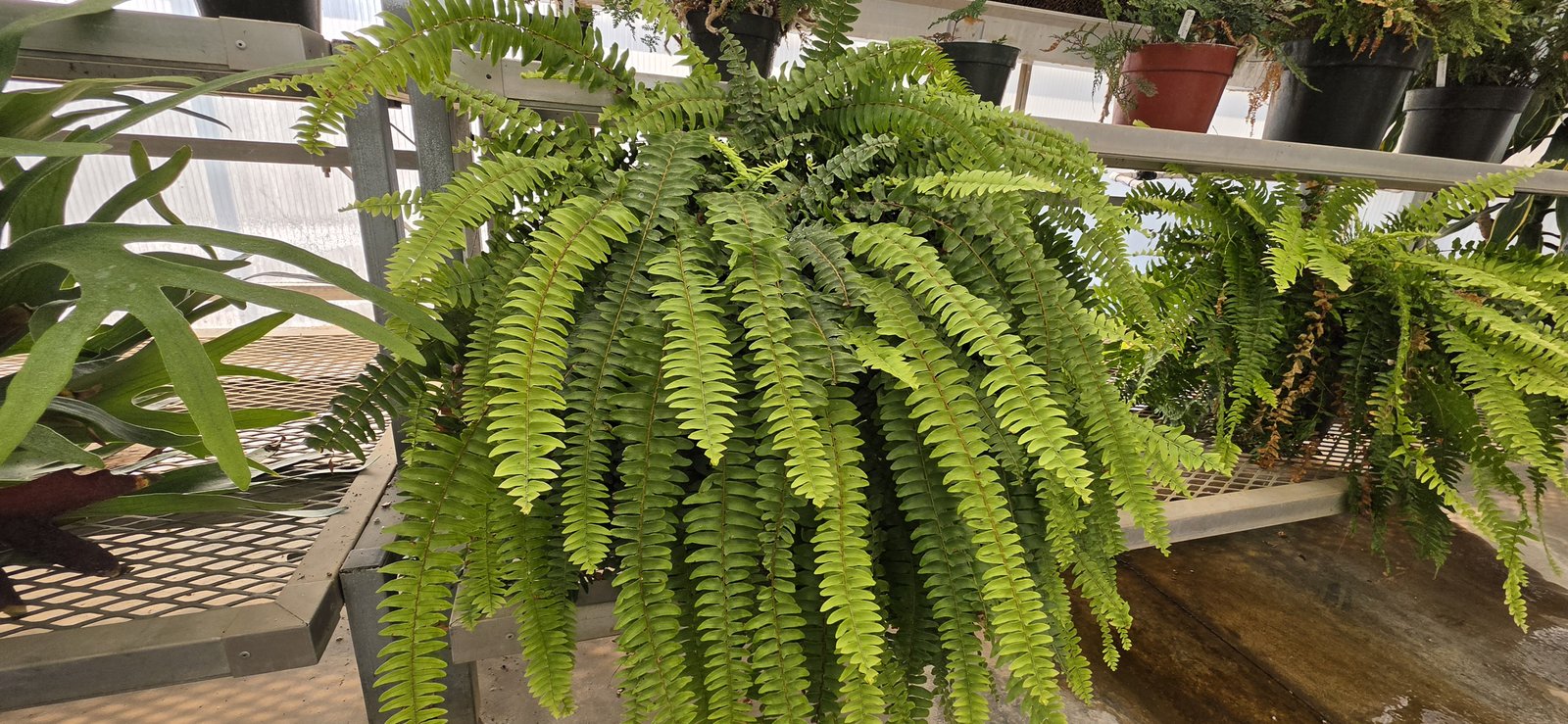
Nephrolepis exaltata · Boston Fern
CON-0019
📍 Location not set
Identification
Nephrolepis exaltata · Boston Fern
The plant shows a dense, cascading rosette of arching pinnate fronds typical of Nephrolepis species. Each frond is a single pinnate (once-divided) leaf with numerous small, narrow, slightly overlapping pinnae (leaflets) with finely serrated to entire margins, tapering to a point - characteristic of Nephrolepis exaltata (Boston Fern) or one of its cultivars. The growth habit (hanging basket, dense trailing fronds) and greenhouse context (visible alongside other hanging ferns and Platycerium/staghorn fern on the left) support this being a commonly cultivated fern for hanging display. However, other Nephrolepis species/cultivars (e.g., N. cordifolia 'Duffii', N. biserrata, or fishbone fern) can look similar, and without a clear view of the rhizome, spore pattern (sori arrangement on frond underside), or scale characteristics, I can't rule out a related cultivar with full certainty. A close-up of the frond underside showing sori placement, and the base/rhizome structure, would help confirm the exact species.
Generated 2026-08-14 22:57 by anthropic (claude-sonnet-5).
Health
Care Information
- Light
- Bright, indirect light; keep out of direct sun which scorches fronds, but avoid deep shade which causes leggy growth.
- Water
- Keep soil consistently moist but not soggy; water when the surface just starts to dry out, roughly every 5-7 days. Never let it dry out completely or fronds will brown and drop.
- Nutrients
- Feed with a diluted balanced liquid fertilizer every 2-4 weeks during spring through fall; skip feeding in winter.
- Repotting
- Repot annually or every other year in spring once roots fill the pot; Boston ferns are vigorous growers and benefit from fresh mix and occasional division.
- Soil media
- Rich, well-draining potting mix high in organic matter -- a peat-based or standard potting soil with added perlite works well.
- Temp & humidity
- 65-75F, avoid drafts and sudden temperature drops; needs high humidity (50%+) -- mist regularly or place on a pebble tray, especially in dry conservatory rooms.
- Temperature range
- 🌡️ 65-75F
- Humidity range
- 💦 50%+
- Care group
- 🏷️ Low Light & Humid
- Toxicity
- Non-toxic to humans and pets; safe for public areas with foot traffic.
- Pests & diseases
- Watch for spider mites and mealybugs, especially in dry air; scale can also appear. Root rot occurs if overwatered or left in standing water, and fronds brown/drop readily if humidity is too low.
- Propagation
- Division at repotting -- separate rooted plantlets/runners from the main clump.
Generated 2026-08-21 17:43 by anthropic (claude-sonnet-5).