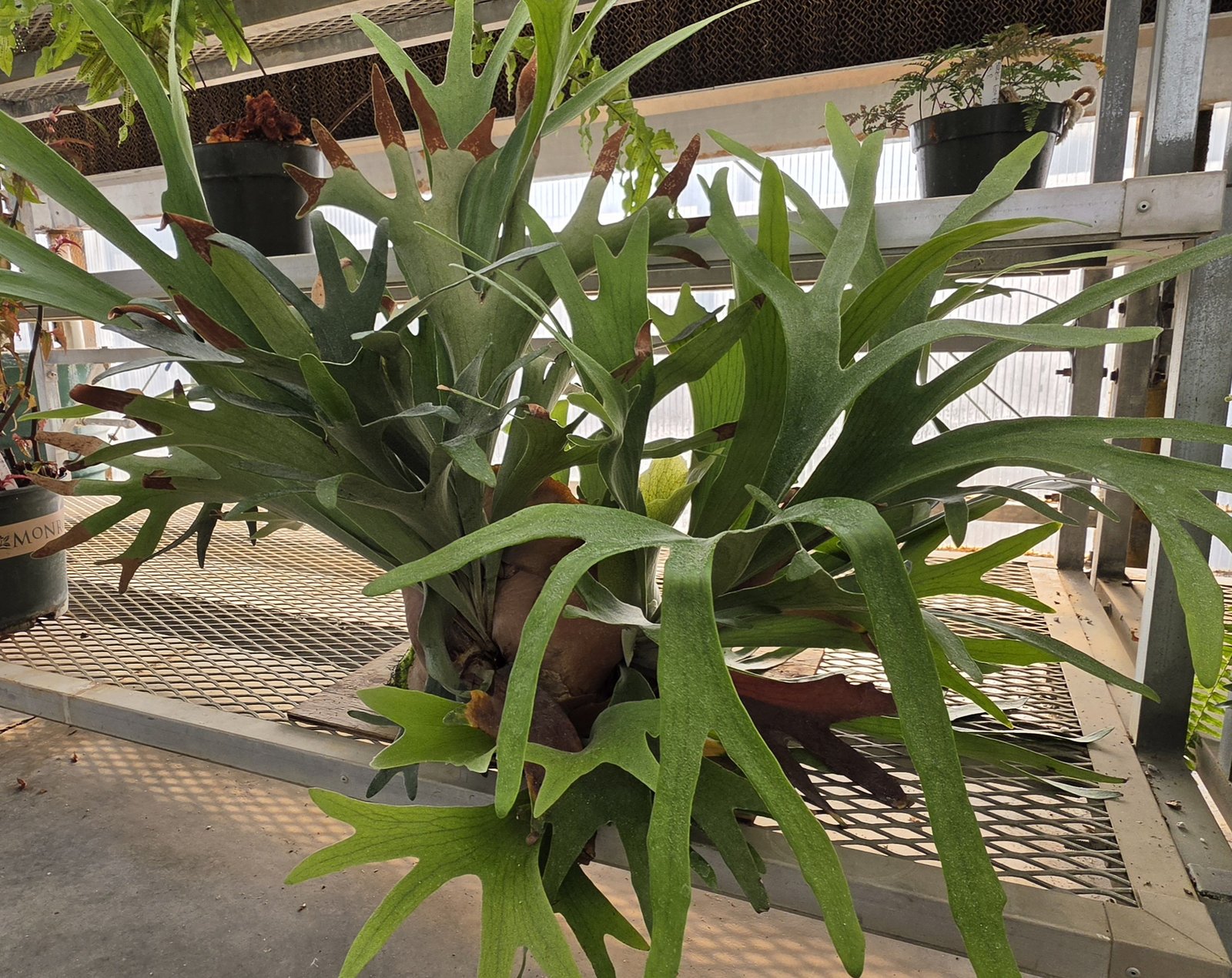
Platycerium bifurcatum · Staghorn Fern
CON-0018
📍 Location not set
Identification
Platycerium bifurcatum · Staghorn Fern
The plant shows the classic morphology of a Platycerium: green, antler-like fertile fronds that fork repeatedly into narrow lobes, covered in fine grayish-green fuzz (trichomes), arising from a basal clump of rounded, shield-shaped sterile 'nest' fronds that clasp a mounting substrate (visible as brown, papery/shield fronds at the base). The plant is mounted rather than potted in soil, consistent with epiphytic staghorn fern culture, and it's hanging among other ferns in what appears to be a greenhouse fern collection. The fork pattern and moderate frond width are most consistent with P. bifurcatum, the most commonly cultivated staghorn fern species, though similar-looking relatives such as P. willinckii (more pendulous, silvery fronds), P. veitchii (more silvery, upright fronds), or hybrids like P. 'Netherlands' could produce a similar look. Without a clearer view of the sterile shield fronds' shape/color and spore patches on the fertile fronds, I can't rule out these close relatives with full certainty, hence 'probable' rather than 'certain'.
Generated 2026-08-24 22:47 by anthropic (claude-sonnet-5).
Health
Care Information
- Light
- Bright, indirect light; some morning direct sun is fine but protect from harsh midday direct sun which can scorch fronds.
- Water
- Water thoroughly by soaking or dunking the mount/pot when the shield fronds feel dry, then let it dry out fully before watering again -- roughly every 7-10 days indoors.
- Nutrients
- Feed lightly with a balanced liquid fertilizer at half strength monthly during spring through summer; skip fertilizing in fall and winter.
- Repotting
- Rarely needs repotting since it's usually mounted; if potted, move to a larger basket only when it outgrows its support, every 2-3 years.
- Soil media
- Not grown in soil -- mount on wood/bark with sphagnum moss, or use a very chunky, fast-draining epiphytic mix if potted.
- Temp & humidity
- 65-80F; moderate to high humidity (50-70%) -- mist regularly or hang near other humidity-loving plants.
- Temperature range
- 🌡️ 65-80F
- Humidity range
- 💦 50-70%
- Care group
- 🏷️ Bright & Humid
- Toxicity
- Non-toxic to pets and people; safe near visitors and foot traffic.
- Pests & diseases
- Watch for scale insects, especially on the underside of shield fronds; root/rhizome rot occurs if kept constantly wet or if the mount doesn't dry between waterings.
- Propagation
- Divide offset 'pups' from the base of an established plant, keeping some root and shield frond attached, and mount separately.
Generated 2026-08-24 22:47 by anthropic (claude-sonnet-5).