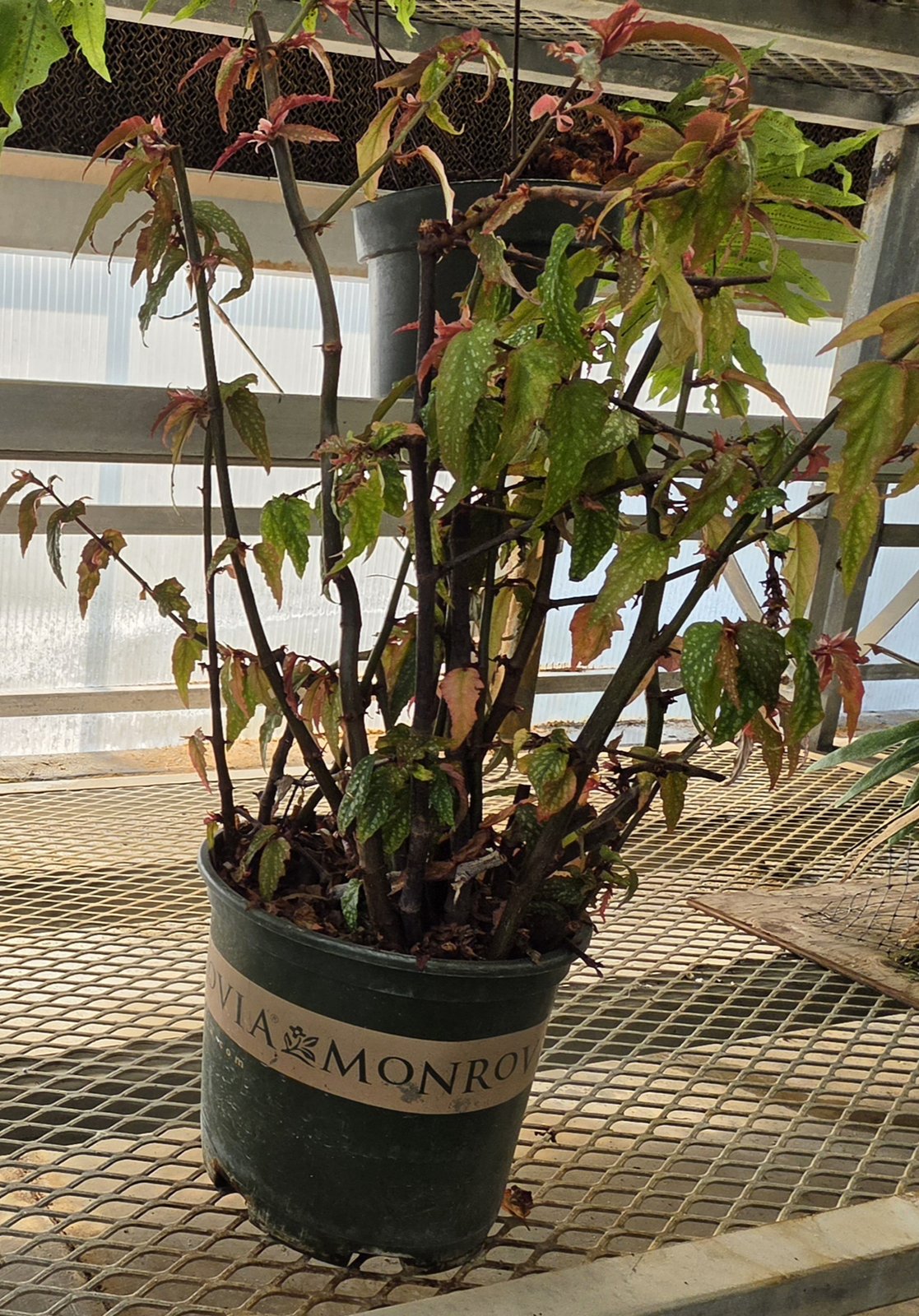
Begonia corallina 'Lucerna' · Angel-wing Begonia (Lucerna)
CON-0017
📍 Location not set
Identification
Begonia corallina 'Lucerna' · Angel-wing Begonia (Lucerna)
The plant shows the classic features of an angel-wing type cane begonia: jointed, bamboo-like stems with swollen nodes, asymmetric wing-shaped leaves with silvery-white spotting on the upper surface, and reddish new growth/leaf undersides. This spotted-leaf pattern combined with the cane growth habit is highly characteristic of the 'Lucerna' cultivar (a hybrid long associated with B. corallina), which is one of the most common large angel-wing begonias in cultivation. I'm not rating this as certain because several closely related angel-wing cultivars (e.g., 'Sophie Cecile', 'Irene Nuss', and other B. coccinea hybrids) share very similar silver-spotted cane foliage, and without a flower cluster (the pendulous coral-pink flowers would be diagnostic) or a clearer close-up of leaf margin serration, I can't fully rule out those lookalikes. The specific suspicion of B. corallina 'Lucerna' is consistent with everything visible here, so I'm adopting it as the best differentiated guess beyond simply 'cane-type begonia.' A photo of an open flower truss or a sharp close-up of a single leaf (showing margin texture and spot size/density) would allow a more certain call.
Generated 2026-10-06 17:57 by anthropic (claude-sonnet-5).
Health
Care Information
- Light
- Bright, indirect light; an east or shaded south/west window works well. Avoid direct midday sun which can scorch the cane-like leaves.
- Water
- Water thoroughly when the top inch of soil is dry, then let it approach dryness again before the next watering. Reduce frequency in winter to avoid rot.
- Nutrients
- Feed with a balanced liquid fertilizer diluted to half strength every 2-4 weeks during spring through summer; withhold in winter.
- Repotting
- Repot every 1-2 years in spring, or when rootbound; this cane-type begonia doesn't mind being slightly snug in its pot.
- Soil media
- Well-draining potting mix amended with perlite and some organic matter (e.g. peat or coco coir) for good aeration and drainage.
- Temp & humidity
- 65-80F; moderate to high humidity (50%+) - a pebble tray or nearby humidifier helps, especially in drier conservatory rooms.
- Temperature range
- 🌡️ 65-80F
- Humidity range
- 💦 50%+
- Care group
- 🏷️ Bright & Humid
- Toxicity
- Contains soluble calcium oxalates; mildly toxic if chewed or ingested by pets or people, causing mouth/GI irritation - keep away from browsing animals and small children.
- Pests & diseases
- Watch for powdery mildew and botrytis in stagnant humid air, and spider mites/mealybugs in drier conditions; ensure good air circulation. Prone to stem/root rot if overwatered or soil stays soggy.
- Propagation
- Stem cuttings root readily in moist potting mix or water; take a cutting with at least one node and a couple of leaves, and keep humidity elevated until rooted.
Generated 2026-08-24 22:58 by anthropic (claude-sonnet-5).