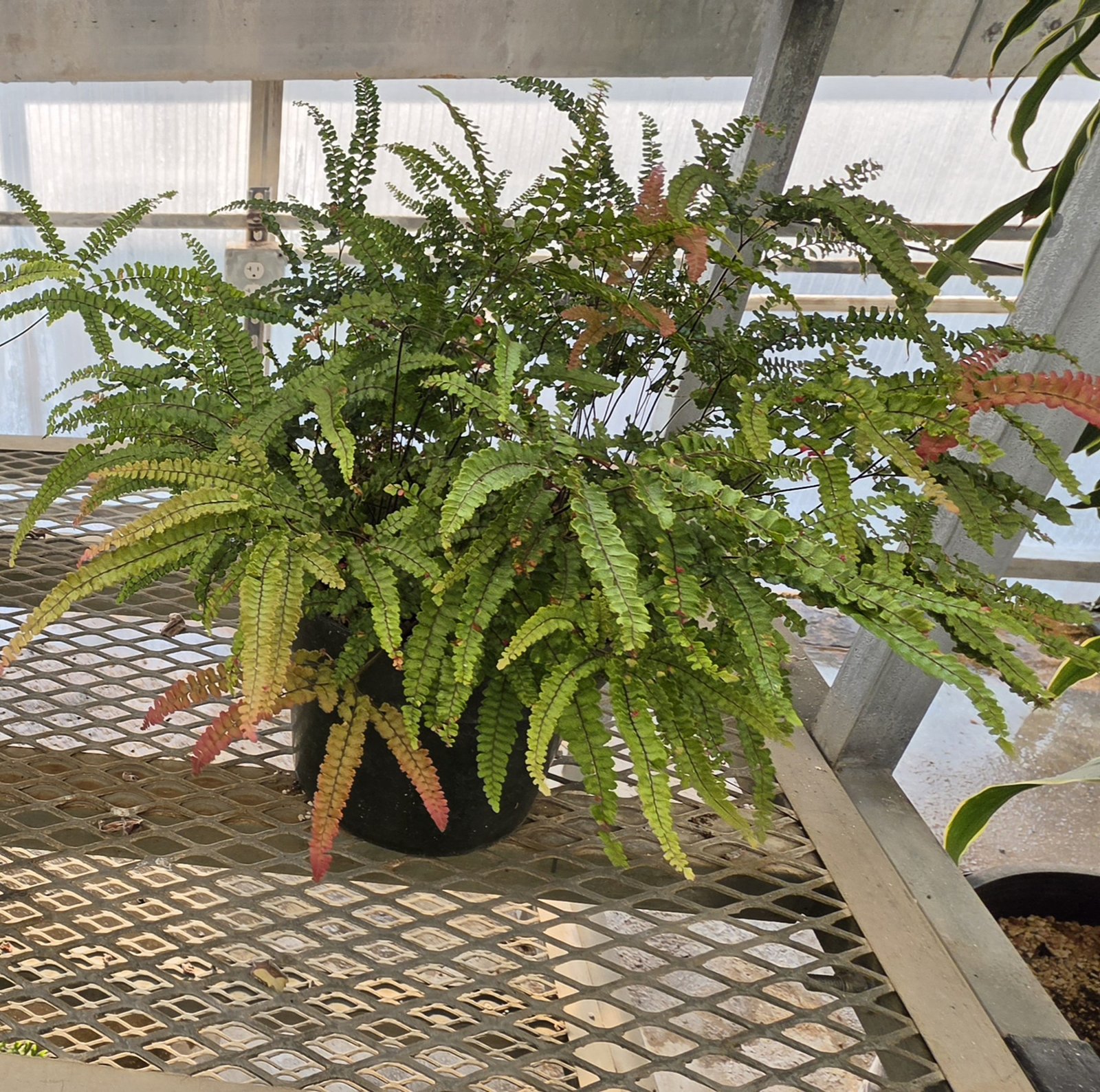
Adiantum hispidulum · Rosy maidenhair fern
CON-0011
📍 Location not set
Identification
Adiantum hispidulum · Rosy maidenhair fern
The fronds show small, rounded to wedge-shaped pinnae arranged pinnately along thin, dark wiry stalks, with a mounding, arching growth habit typical of maidenhair ferns. Notably, many of the newer fronds emerge with a distinct coppery-pink to red coloration before maturing to green, which is a hallmark trait of Adiantum hispidulum. This pink new growth rules out Pellaea rotundifolia (which has uniformly leathery, dull green, more rounded, alternating pinnae without pink flush) and Nephrolepis exaltata (which has simple, undivided strap-like pinnae along a single frond axis, not the branching, twice-divided fan-like pattern seen here). The overall branching pattern with dark rachis splitting into multiple frond segments is consistent with Adiantum rather than a true sword fern. That said, other Adiantum species (e.g., A. raddianum cultivars) can look similar, so species-level certainty would benefit from a closer image of the sori (spore clusters) on the pinnae margins and a clearer view of the rachis branching pattern near the base.
Generated 2026-08-13 21:44 by anthropic (claude-sonnet-5).
Health
Care Information
- Light
- Bright, indirect light or dappled shade; avoid direct sun which can scorch the delicate fronds.
- Water
- Keep soil consistently moist but not waterlogged; water as soon as the surface starts to feel dry, and never let it dry out completely.
- Nutrients
- Feed with a diluted balanced liquid fertilizer (about half strength) monthly during spring and summer; skip feeding in fall and winter.
- Repotting
- Repot annually or every other year in spring as it outgrows its pot, using a light, well-draining, humus-rich mix.
- Soil media
- Well-draining, humus-rich potting mix -- a standard peat-based or soilless mix with added perlite for aeration and moisture retention.
- Temp & humidity
- Prefers 60-80F with high humidity (60%+); place on a pebble tray or mist regularly, especially in drier conservatory zones, to prevent frond browning.
- Temperature range
- 🌡️ 65-80F
- Humidity range
- 💦 50-70%
- Care group
- 🏷️ Low Light & Humid
- Toxicity
- No known toxicity concerns for pets or people; safe to display near public foot traffic.
- Pests & diseases
- Watch for spider mites and scale, especially in low-humidity conditions; root or crown rot can occur if overwatered or soil stays soggy.
- Propagation
- Division at repotting time -- separate clumps with rhizome and roots attached and pot into moist mix.
Generated 2026-08-26 21:04 by anthropic (claude-sonnet-5).