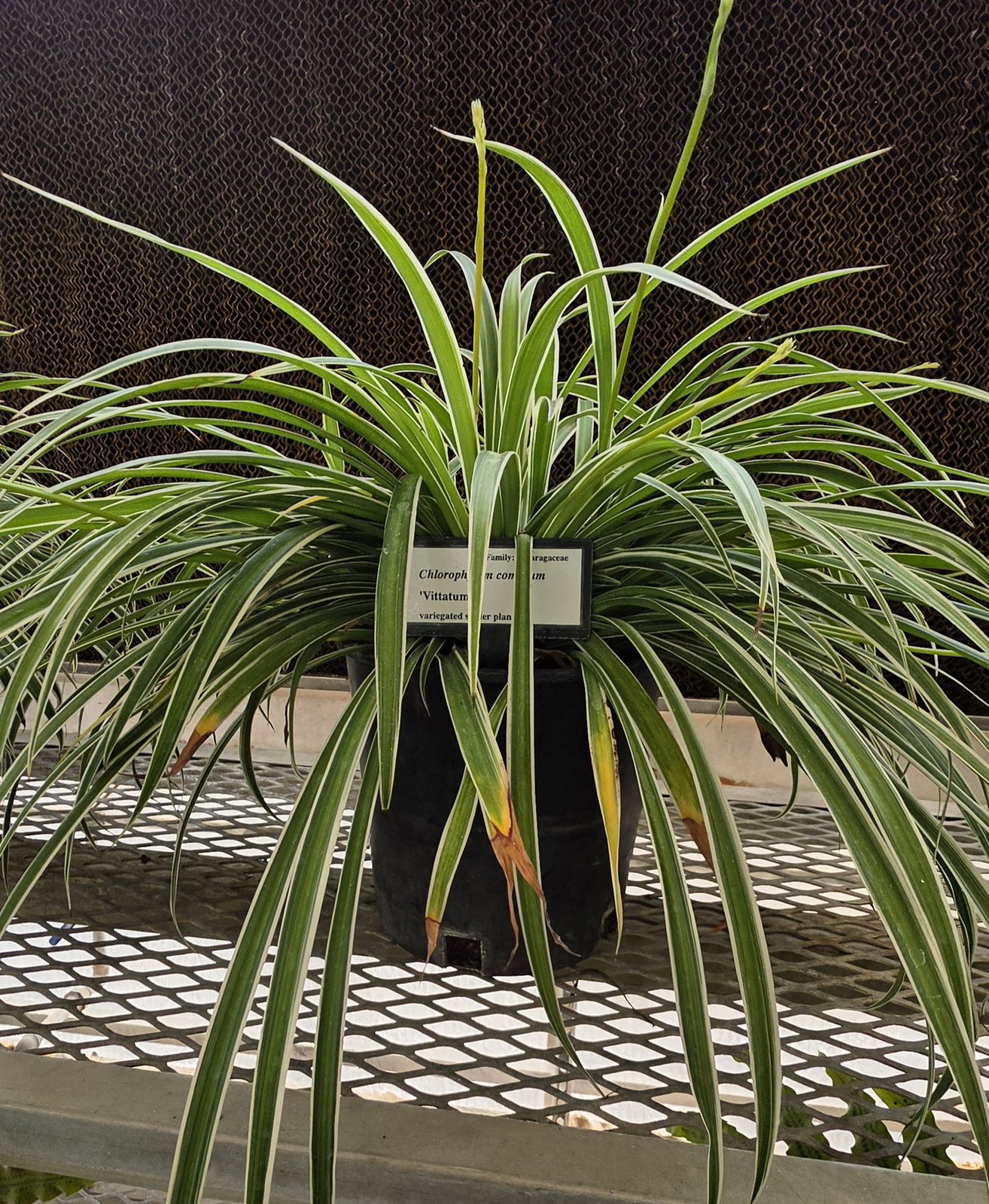
Chlorophytum comosum 'Vittatum' · Variegated Spider Plant
CON-0004
📍 Location not set
Identification
Chlorophytum comosum 'Vittatum' · Variegated Spider Plant
The plant's identity is confirmed directly by the legible label in the photo, which reads 'Chlorophyt[um] com[osum] 'Vittatum'', Family Ar[gh]a[l]aceae [Asparagaceae], 'variegated s[p]ider plan[t]'. This matches the visual features perfectly: long, narrow, arching, grass-like leaves with a central white/cream stripe (the 'Vittatum' cultivar has the stripe down the middle, as opposed to 'Variegatum' which has white margins), arising in a dense rosette from a central crown, with a mounding/cascading growth habit typical of a mature spider plant grown in a hanging or elevated pot. Some leaf tips show yellow-brown dieback, consistent with typical minor tip burn from fluoride/salt buildup or low humidity, but this doesn't affect the identification. No flowers or plantlets are visible, but the label combined with the classic linear-lanceolate variegated foliage makes this a certain ID.
Generated 2026-08-13 06:50 by anthropic (claude-sonnet-5).
Health
Care Information
- Light
- Bright, indirect light tolerates some shade well; avoid direct hot sun which can bleach or scorch the variegated leaves.
- Water
- Water when the top inch of soil dries out, roughly once a week; reduce watering in winter. Sensitive to fluoride/chlorine and salt buildup, which can cause brown leaf tips.
- Nutrients
- Balanced liquid fertilizer diluted to half strength monthly during spring and summer; skip fertilizing in fall and winter.
- Repotting
- Repot every 1-2 years or when rootbound and producing plantlets/offsets crowd the pot; spring is the best time.
- Soil media
- Standard well-draining potting mix works well.
- Temp & humidity
- 65-80F; tolerates average room humidity (40%+) but appreciates slightly higher humidity for lush growth.
- Temperature range
- 🌡️ 65-80F
- Humidity range
- 💦 40%+
- Care group
- 🏷️ Medium Light & Moderate Humidity
- Toxicity
- Non-toxic to humans and pets, though cats and dogs sometimes chew the grass-like leaves and may vomit from ingesting large amounts.
- Pests & diseases
- Generally trouble-free; watch for spider mites and mealybugs in dry conditions, and root rot from overwatering. Brown leaf tips often result from fluoridated tap water or dry air rather than pests.
- Propagation
- Very easy to propagate from the plantlets (spider babies) produced on long stolons; simply pot up a plantlet with aerial roots in soil or root it in water first, then separate from the mother plant.
Generated 2026-08-24 23:00 by anthropic (claude-sonnet-5).