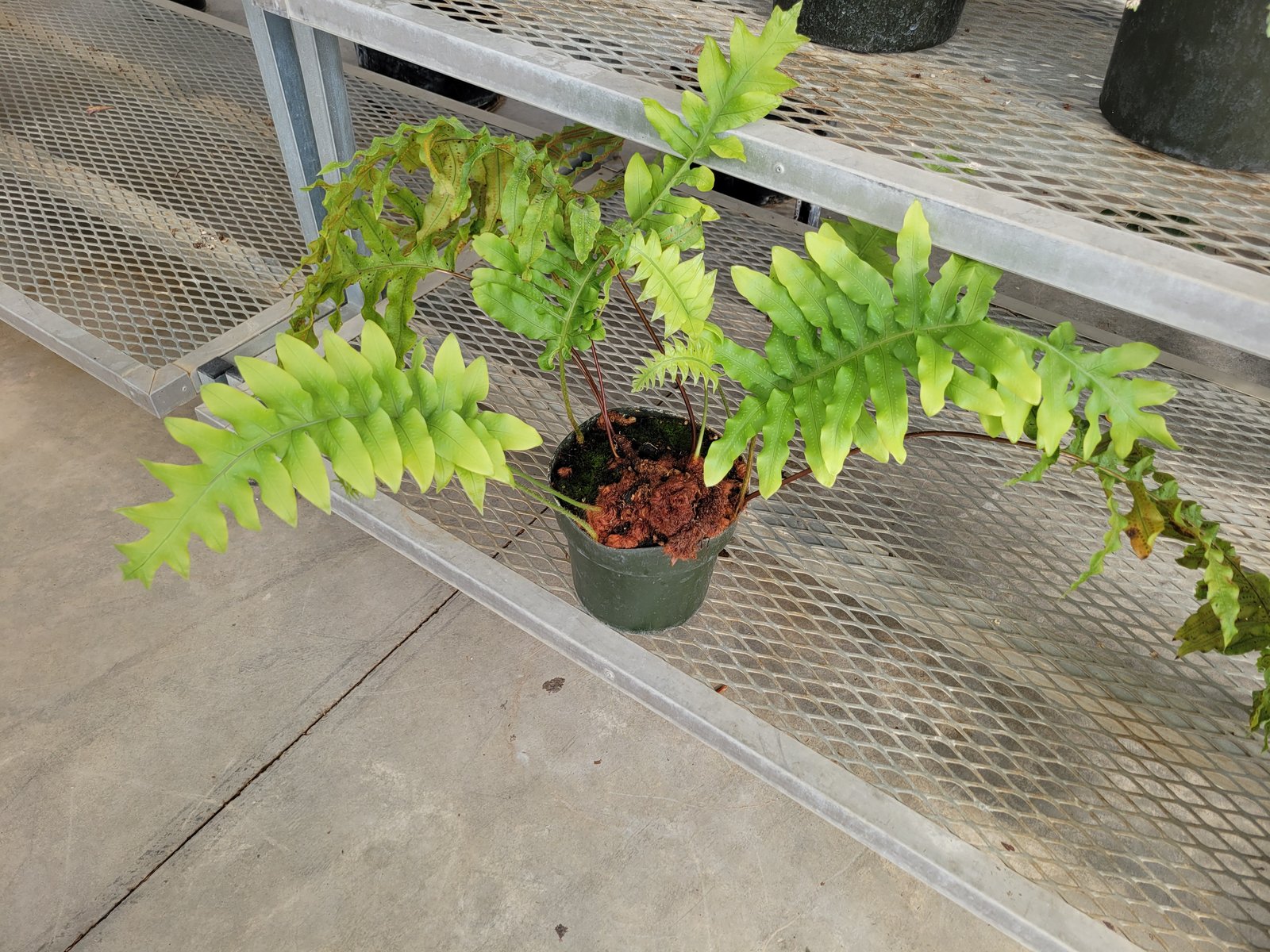
Microsorum diversifolium · Kangaroo paw fern
CON-0002
📍 Location not set
Identification
Microsorum diversifolium · Kangaroo paw fern
The plant shows the characteristic growth habit of kangaroo paw fern: a thick, creeping rhizome covered in fuzzy reddish-brown scales sitting on top of the soil, with wiry dark stipes (petioles) arching out in a fan before the leaf blades begin. The fronds themselves are deeply pinnatifid/almost pinnate, divided into narrow, finger-like lobes with wavy margins - much more deeply cut than the broader, shallow-lobed fronds of Phymatosorus grossus, and completely different from the simple, undivided strap-shaped fronds of Microsorum punctatum (both of which have already been ruled out). This deep, narrow lobing combined with the exposed hairy rhizome is most consistent with Microsorum diversifolium (syn. Phymatosorus diversifolius), commonly sold as kangaroo paw fern. A possible alternative to rule out would be Microsorum scolopendria, which has somewhat similar lobing but typically broader, fewer segments and a less hairy rhizome; a closer photo of the rhizome scales and sori (fertile dot) arrangement on the underside of a frond would help confirm the exact species.
Generated 2026-10-06 17:53 by anthropic (claude-sonnet-5).
Health
Care Information
- Light
- Medium to bright indirect light; avoid direct sun which can scorch the fronds. Tolerates lower light but growth slows.
- Water
- Keep soil or mount lightly and evenly moist; water when the surface just starts to dry out, and never let it fully dry or stay soggy.
- Nutrients
- Dilute (half-strength) balanced liquid fertilizer monthly during spring through fall; skip in winter -- ferns are sensitive to fertilizer salt buildup.
- Repotting
- Repot every 1-2 years in spring when rootbound; this fern has a shallow, often creeping rhizome so use a wide shallow pot rather than a deep one.
- Soil media
- Loose, well-draining, chunky mix -- e.g. standard potting soil amended with orchid bark, perlite, and peat/coir -- since these are epiphytic/semi-epiphytic ferns in habitat.
- Temp & humidity
- 65-80F; high humidity (50-70%+) -- mist regularly, use a pebble tray, or place in a humid conservatory zone away from drafts and heat vents.
- Temperature range
- 🌡️ 65-80F
- Humidity range
- 💦 50-70%+
- Care group
- 🏷️ Low Light & Humid
- Toxicity
- No known toxicity concerns to pets or people.
- Pests & diseases
- Generally trouble-free; watch for scale and mealybugs, and root/rhizome rot if kept too wet or in poorly draining media.
- Propagation
- Divide the creeping rhizome into sections with fronds and roots attached, then pot separately in moist fern mix.
Generated 2026-08-16 21:28 by anthropic (claude-sonnet-5).